














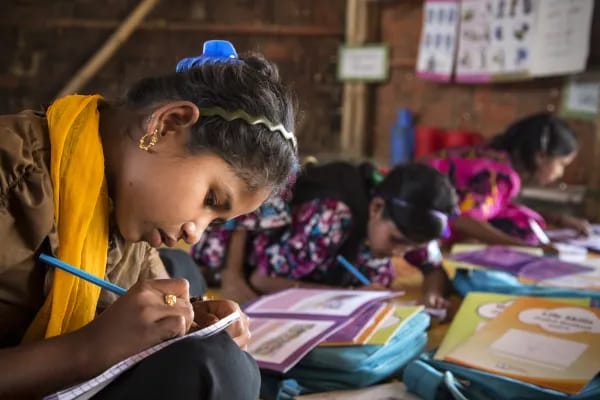
India has succeeded in taking education to millions of children who might once have remained outside the classroom. Schools have expanded, universities have multiplied, digital platforms have widened access, and the National Education Policy has offered an ambitious vision of multidisciplinary, flexible and skill-oriented learning.
Yet one uncomfortable question must now be asked: What is the true value of access if education does not result in learning, capability, confidence and livelihood?
A child may attend school for ten or twelve years and still struggle to read with comprehension, apply elementary mathematics or communicate an idea. A young person may complete a university degree yet remain inadequately prepared for employment, entrepreneurship or responsible citizenship. An institution may achieve impressive enrolment numbers without knowing whether its students have genuinely learned.
This is the distance India must urgently close—the distance between attendance and understanding, qualification and competence, education and life.
The transformation cannot be secured merely by rewriting curricula or introducing additional digital platforms. It begins with the teacher. Technology, including artificial intelligence, can personalise lessons, translate content and reduce administrative work. But it cannot replace the moral encouragement, observation, judgment and human connection of a committed teacher.
India must therefore place teacher quality and dignity at the centre of educational reform. Recruitment vacancies should be filled transparently. Teachers must receive continuous professional development, mentoring and access to useful classroom tools. Equally important, they should be relieved of avoidable non-academic duties that consume the time intended for students.
Educational assessment also requires reform. Examinations that reward memorisation may produce impressive marks without demonstrating curiosity, reasoning or practical ability. Schools and universities should progressively assess comprehension, problem-solving, communication, collaboration and the application of knowledge.
The relationship between education and industry needs similar reconstruction. Industry frequently complains that graduates are not employment-ready, while academic institutions complain that employers demand experience from young people who have never been given an opportunity to acquire it. Both sides are correct—and both must accept responsibility.
Every university and college should establish structured partnerships with employers, local enterprises, hospitals, laboratories, farms, civil-society institutions and public agencies. Apprenticeships and supervised workplace learning should become recognised components of academic programmes, not optional activities undertaken by a fortunate minority. Recent emphasis on apprenticeship-embedded degrees is welcome, but implementation must extend beyond a limited group of institutions. opengovasia.com
The digital and AI revolution introduces another responsibility. Students in well-resourced institutions may have access to advanced laboratories, high-speed connectivity and AI tutors, while children elsewhere share devices or struggle with unreliable internet. If this divide is ignored, technology will enlarge educational inequality rather than reduce it.
Government must establish a national minimum digital entitlement for every learner: dependable connectivity, age-appropriate digital content, teacher support, assistive technologies for students with disabilities and clear safeguards governing children’s data.
Industry leaders, too, must look beyond recruitment from a small circle of established campuses. They should adopt government schools and regional colleges through long-term partnerships, train teachers, create apprenticeships and publish the competencies they expect from future employees. Corporate social responsibility in education should be judged by measurable learning improvement—not the number of devices distributed or classrooms painted.
India does not need another generation holding certificates that society celebrates but the economy cannot use. It needs educated young people capable of thinking independently, working productively, acting ethically and continuing to learn.
The bridge from the village classroom to the university, laboratory, workplace and enterprise must not remain broken halfway. Repairing it is not the responsibility of the Education Ministry alone. It is a national obligation shared by governments, teachers, parents, universities and industry.
The success of Indian education will not finally be measured by how many children entered an institution. It will be measured by how confidently they entered life.