












By Dr Rajiv Kalebar and Dr Swetha.N
When one thinks of finance education, numbers, charts, and rational decision-making usually comes to mind. But what if the key to understanding investor behaviour, biases, and moneyrelated emotions lies not just in data — but also in the body?
Swetha Harsha and Rajiv Kalebar, educators and innovators in the fields of finance and expressive arts, are bridging this unlikely gap through a bold and interdisciplinary approach: Integrating Dance Movement Therapy (DMT) into Behavioural Finance education. Their work was recently showcased at IIM Ahmedabad, where they presented this pioneering concept to scholars and educators at a national-level academic forum.
Why Movement Matters in Money
 Behavioural Finance explores how cognitive biases, emotions, and psychological influences affect financial decisions. Traditional teaching focuses on theory, case studies, and simulations. However, Swetha and Rajiv believe that these concepts come alive more effectively when paired with embodied learning — a method that engages the body as a tool for awareness and reflection.
“Financial decisions aren’t purely logical. They are rooted in fear, risk aversion, impulsivity, and past experiences,” says Swetha, who combines her background in Dance Movement Therapy and management education. “Movement bypasses mental defences and allows individuals to feel and explore these emotions physically.”
A Classroom in Motion
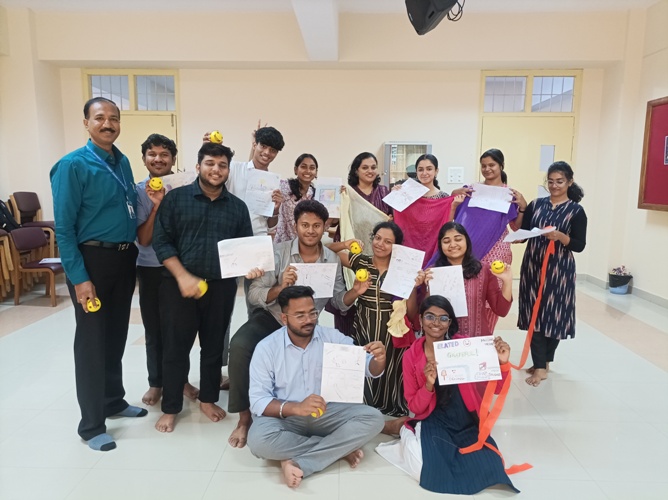
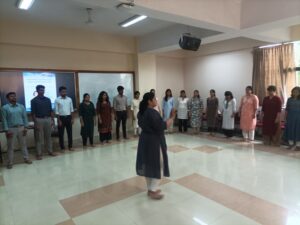
In workshops with MBA and undergraduate students, the duo uses structured movement exercises, mirroring activities, and improvisation to bring behavioural finance concepts to life. For example, while exploring loss aversion, students enact the emotional weight of losing a prized object through movement. When discussing herd mentality, they participate in synchronized group patterns that highlight how easily people follow dominant cues.
One such activity, titled “The Invisible Hand”, involves navigating the space blindfolded with only others’ movements to guide them — a powerful metaphor for market sentiment and groupthink.
These sessions are followed by reflective writing, financial case analysis, and discussions linking movement experiences to behavioural theory.
On-the-Ground Impact
Swetha and Rajiv are not just theorizing — they are actively conducting DMT-based interventions with students across various institutions, including Christ Deemed to be University, where MBA students of finance specialization have engaged in this unique format of learning. The feedback has been overwhelmingly positive: students report deeper understanding and retention of complex concepts, increased self-awareness of their own biases, and a renewed sense of connection to money as an emotional subject.
“I never realized how anxious I felt about money until I tried expressing it through movement,” shared a Christ University student. “It made me more conscious of the stories I tell myself about risk.”
Reimagining Financial Education in India
This initiative is among the first of its kind in Indian higher education. With the rise of emotional investing, crypto volatility, and financial anxiety among youth, educators need new methods to engage learners beyond traditional cognitive frameworks.
Rajiv, a behavioural finance specialist, adds, “Data gives us patterns, but DMT reveals the story underneath. When students connect with their financial behaviour somatically, they become more ethical, mindful, and grounded decision-makers.”
The Road Ahead
After the success of their presentation at IIM Ahmedabad, Swetha and Rajiv are now in the process of documenting their methodology and outcomes, and are in conversations with institutions to develop interdisciplinary electives that blend expressive arts, psychology, and finance.
Their message is clear: the future of finance education isn’t just in smarter algorithms or market predictions — it’s also in movement, mindfulness, and embodied understanding.
Dr Rajiv Kalebar is a behavioural finance expert, Associate Professor, Finance Department, Christ (Deemed to be University) exploring emotional intelligence in financial decision-making.
Dr Swetha.N is a Dance Movement Therapy facilitator and Associate Professor at Alliance University in the field of Management focusing on integrating expressive arts into business education.